


Chinese Herbs for Uterine Health: A Natural Path to Wellness
Traditional Chinese herbs offer a time-honored, natural approach to supporting female reproductive wellness.
Chinese herbs for uterine health have been helping women for thousands of years, offering natural solutions for everything from painful periods to fertility challenges. If you’re looking for gentle, effective ways to support your reproductive wellness, here are the key benefits:
Top Chinese Herbs for Uterine Health:
- Dang Gui (Angelica) – Regulates cycles and reduces pain
- Bai Shao (White Peony) – Calms cramps and nourishes blood
- Yi Mu Cao (Motherwort) – Supports healthy menstruation
- Shu Di Huang (Rehmannia) – Strengthens reproductive energy
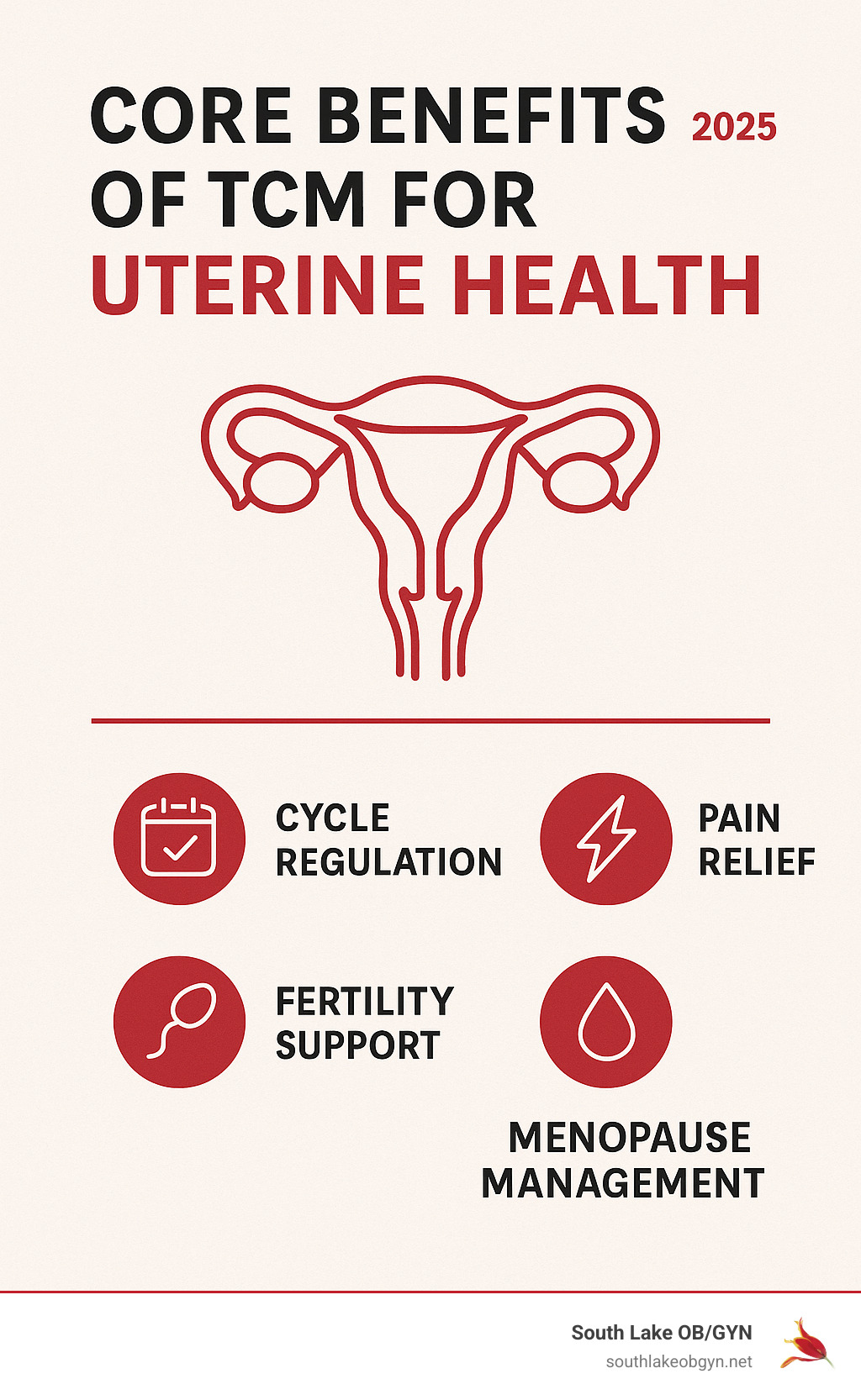
Traditional Chinese Medicine offers four main pathways to uterine wellness: cycle regulation, pain relief, fertility support, and menopause management.
Uterine health challenges affect millions of women. Fibroids alone impact up to 80% of women by age 50, while irregular cycles, painful periods, and fertility struggles touch countless others. Modern medicine offers important treatments, but many women seek gentler, more holistic approaches.
Traditional Chinese Medicine (TCM) views your body as an interconnected system where balance creates health. Rather than just treating symptoms, TCM practitioners look at the whole picture – your energy flow, blood circulation, and organ harmony.
This ancient wisdom doesn’t replace modern gynecological care. Instead, it offers a complementary path that can work alongside conventional treatments to support your body’s natural healing abilities.
As Dr. Matthew Casavant, I’ve spent over 20 years helping women steer their reproductive health journeys, and I’ve seen how integrating chinese herbs for uterine health with modern care can provide comprehensive support for my patients. My holistic approach combines the precision of advanced medical training with time-tested natural healing methods.
Handy chinese herbs for uterine health terms:
The TCM Perspective: Understanding Your Body’s Inner Harmony
In Traditional Chinese Medicine, your body is a connected system. A TCM practitioner doesn’t just see a uterine fibroid; they ask what underlying imbalance allowed it to form. The uterus is honored as the “Palace of the Child,” the center of reproductive power, reflecting its deep connection to your overall well-being.
Your health depends on the harmony of four fundamental elements:
- Qi (pronounced “chee”): Your vital life force. When Qi flows smoothly, you feel energized and healthy. When it’s stuck or deficient, problems arise.
- Blood: More than just the liquid in your veins, Blood is a substance that carries Qi, nourishes your body, and supports healthy periods and fertility.
- Yin and Yang: The two opposing but complementary forces. Yin represents coolness, stillness, and nourishment. Yang provides warmth, movement, and energy. Uterine health requires a balance of both.
Three key organ systems orchestrate this balance:
- Kidney: Stores your core reproductive energy, governing your health through life’s cycles.
- Liver: Ensures the smooth flow of Qi and Blood, which is crucial for an easy, regular menstrual cycle.
- Spleen: Transforms food into the Qi and Blood your body needs to thrive.
TCM’s strength lies in pattern differentiation. Instead of a one-size-fits-all approach, a practitioner identifies your unique pattern of imbalance—be it stuck energy, deficient nourishment, or excess heat or cold—to create a personalized herbal formula.

A neat diagram illustrating the flow of Qi and Blood through the meridians related to the uterus.
How TCM Views Common Uterine Conditions
TCM understands common conditions through its unique lens:
Blood Stasis: This pattern is often behind uterine fibroids. TCM sees fibroids as accumulations where Qi and Blood have stagnated, like a logjam in a stream. This can result from chronic stress, internal coldness, or a lack of Qi. Research shows that combining chinese herbs for uterine health with modern treatments can help reduce fibroid size by breaking up this stagnation.
Qi and Blood Deficiency: If your periods are light, pale, or irregular, and you feel tired or dizzy, your body may lack the vital resources for a robust cycle. It’s like trying to run on an empty tank.
Liver Qi Stagnation: This is the classic PMS pattern: irritability, mood swings, breast tenderness, and cramping. It happens when your Liver system, which governs emotional and energetic flow, becomes constrained.
Kidney Yin and Yang Decline: As menopause approaches, these energies naturally decline. Kidney Yin Deficiency can cause hot flashes, night sweats, and anxiety. Kidney Yang Deficiency may lead to fatigue, feeling cold, and low libido. TCM uses herbs to gently support these energies, easing the menopausal transition.
A Guide to Key Chinese Herbs for Uterine Health
Think of chinese herbs for uterine health as a team—each herb has a unique role, but they create magic when combined in a formula. This teamwork is what makes Chinese herbal medicine so powerful and personalized. A formula might simultaneously nourish blood, improve circulation, calm the nervous system, and strengthen digestion.
Key herb categories include:
- Blood-nourishing herbs: Rebuild depleted resources, ideal for light periods or fatigue.
- Blood-moving herbs: Clear blockages, improve circulation, and relieve pain from stagnation.
- Qi-tonifying herbs: Boost your vital energy to improve all bodily functions.
- Herbs that calm the spirit: Soothe the nervous system, recognizing the deep link between emotions and physical health.
The “Queen of All Female Herbs”: Dang Gui (Angelica Sinensis)
Dang Gui (Angelica sinensis), often called “female ginseng,” is a superstar for women’s health due to its versatility.
- Nourishes and Invigorates Blood: It helps “refill your tank” if you’re feeling run down, pale, or fatigued.
- Regulates Menstruation: It’s a go-to herb for irregular, painful, or absent periods, helping to restore a healthy, regular cycle. A 2004 study showed it improved abdominal pain and cycle regularity.
- Relieves Pain: Its antispasmodic properties are excellent for menstrual cramps.
- Supports Hormonal Balance: It contains natural phytoestrogens that can help smooth out hormonal fluctuations.
- Boosts Fertility: By nourishing blood and improving circulation to the reproductive organs, it helps create a welcoming environment for conception.
Other Foundational Herbs for a Healthy Womb
While Dang Gui is the queen, she works with a court of other powerful herbs:

Close-up shots of key herbs like Bai Shao (White Peony Root) and Chuan Xiong, often found in foundational formulas for uterine health.
- Bai Shao (White Peony Root): A calming herb that nourishes blood and softens the liver, making it perfect for relieving painful menstrual cramps. Research points to its anti-inflammatory and pain-relieving effects.
- Shu Di Huang (Rehmannia Root): A deeply nourishing herb that builds blood and kidney yin. It’s a key ingredient in formulas for fertility, hormonal balance, and depletion.
- Yi Mu Cao (Motherwort): True to its name, this “Mother Herb” invigorates blood circulation and helps regulate the menstrual cycle, making it useful for painful periods and postpartum recovery.
- Xiang Fu (Cyperus Rhizome): The ideal herb for PMS symptoms like bloating, irritability, and pain that are tied to stuck liver energy. It helps smooth emotional and physical tension.
Crafting Your Personalized Herbal Strategy
The power of chinese herbs for uterine health lies in personalization. There is no one-size-fits-all solution. Two women with fibroids might have them for entirely different reasons—one from stress (Liver Qi Stagnation) and the other from fatigue (Qi and Blood Deficiency). A TCM practitioner acts like a detective, gathering clues from your energy levels, sleep, digestion, and emotions to identify your unique pattern of imbalance.
This diagnosis goes beyond a Western medical label. It allows for a formula that addresses the root cause, not just the symptoms. Instead of just masking period pain, we use herbs to warm the uterus, nourish blood, and strengthen Qi, preventing the pain from returning. Your formula may even be adjusted throughout your menstrual cycle to support your body’s changing needs.
Personalizing for Common Uterine Health Concerns
Here’s how herbs are customized for different TCM patterns:
- Blood Stasis: For sharp, stabbing pains, dark clotted periods, or masses like fibroids and endometriosis. Formulas include powerful blood-moving herbs like San Leng and E Zhu, balanced with nourishing herbs.
- Qi Deficiency: For chronic fatigue, a pale complexion, and light periods. Qi-tonifying herbs like Huang Qi (Astragalus) or Ren Shen (Ginseng) are used to rebuild your energy.
- Liver Qi Stagnation: For PMS symptoms like mood swings, irritability, and breast tenderness. Herbs like Chai Hu (Bupleurum) and Xiang Fu smooth out stuck energy for emotional and physical relief.
- Kidney Deficiency: Often underlying fertility issues and menopausal symptoms. Depending on whether you have Yin deficiency (hot flashes, night sweats) or Yang deficiency (fatigue, coldness), specific herbs are used to replenish your foundational energy.
Regulating Cycles, Pain, and Menopause Naturally
- For Irregular Periods: Formulas like the classic Si Wu Tang (Four Substances Decoction) nourish blood and regulate Qi to restore your body’s natural rhythm.
- For Menstrual Pain: If pain is from Blood Stasis, herbs like Yan Hu Suo (Corydalis) get things moving. If it’s from cold, warming herbs like Rou Gui (Cinnamon Bark) bring soothing relief.
- For Menopause Support: For hot flashes, Kidney Yin-nourishing herbs like Sheng Di Huang cool the body. For fatigue and coldness, Kidney Yang-tonifying herbs like Yin Yang Huo can restore your inner warmth.
Integrating Ancient Wisdom with Modern Care
At South Lake OB/GYN, we believe in combining time-tested wisdom with modern medicine. Partnering chinese herbs for uterine health with conventional treatments can produce remarkable results.

A compassionate healthcare provider discussing options with a patient, blending modern and traditional elements to create a comprehensive care plan.
Combining TCM with conventional treatments gives you more tools for your wellness. For uterine fibroids, conventional options are valuable but can have side effects or high recurrence rates. This is where herbs can be powerful allies. A study found that combining the TCM formula Guizhi Fuling Capsule with low-dose mifepristone reduced fibroid size more effectively than either treatment alone, without increasing side effects.
This integrative approach leverages the unique strengths of each system. Open communication between all your healthcare providers is the foundation of safe, effective care. Here at South Lake OB/GYN in Clermont, FL, we foster a family-like atmosphere where you can comfortably discuss all your health choices, ensuring everything works together for your optimal health.
Scientific support for Chinese herbs for uterine health
Modern research is validating what practitioners have known for centuries.
- Uterine fibroids are incredibly common, affecting up to 80% of African-American women and 50% of white women by age 50, making diverse treatment options essential.
- Scientific research on acupuncture and herbs for fibroids shows positive trends, with studies indicating that integrated approaches often lead to better outcomes, such as greater reductions in fibroid size.
- Research on hormonal regulation shows that formulas like Guizhi Fuling Capsule can help regulate FSH, estrogen, and progesterone levels, suggesting herbs help restore hormonal balance, not just mask symptoms.
- Safety and quality control are top priorities. When prescribed by a qualified practitioner, herbs are very safe. However, some herbs can interact with medications, which is why working with a knowledgeable provider is crucial.
Finding a Qualified Practitioner
Choosing the right practitioner is key to your success.
- A thorough consultation is essential. A qualified practitioner will conduct a detailed assessment to understand your unique constitution and health history.
- Look for credentials like L.Ac. (Licensed Acupuncturist) or Dipl. O.M. (Diplomate of Oriental Medicine).
- Ask questions about their experience with uterine health, their diagnostic process, and how they source their herbs.
- Ensure herb quality and safety. A good practitioner uses reputable suppliers and understands potential drug-herb interactions.
Frequently Asked Questions about Chinese Herbs for Uterine Health
It’s natural to have questions when exploring a new approach to wellness. Here are answers to some of the most common questions about chinese herbs for uterine health.
How are Chinese herbs taken?
Chinese herbs are almost always prescribed in formulas, not as single herbs. This teamwork approach allows a practitioner to address your main concern while supporting your overall system. Your practitioner will recommend the best form for you:
- Raw Herb Decoctions: The most traditional and potent method. You boil a custom bag of dried herbs at home to make a tea.
- Concentrated Granules: A convenient modern option. These freeze-dried extracts dissolve in hot water, offering the benefits of a decoction in minutes.
- Patent Pills or Capsules: The easiest option for busy lifestyles, best suited for maintenance or milder conditions.
Are there any side effects?
When prescribed correctly by a qualified practitioner, chinese herbs for uterine health are very safe. Most women experience no side effects. Occasionally, some people report mild, temporary digestive changes as their body adjusts.
It is crucial to tell your TCM practitioner about all medications and supplements you are taking to avoid potential interactions. For example, some herbs can affect blood-thinning medications. Also, disclose any health conditions, as certain herbs are not appropriate during pregnancy or for specific hormone-sensitive conditions.
How long until I see results from Chinese herbs?
The timeline for results varies depending on you and your condition.
- For acute issues, like menstrual pain, many women notice improvement within one to two cycles.
- For chronic conditions, like fibroids, endometriosis, or long-standing fertility challenges, you should expect to commit to several months of consistent use. Deeper healing takes time.
Think of it as nourishing your body’s healing ability from the ground up. With patience and consistency, most women see meaningful improvements within three to six months for chronic conditions.
Accept Your Uterine Well-being Holistically
This guide has shown how chinese herbs for uterine health offer a natural, comprehensive path to wellness. Traditional Chinese Medicine’s power lies in its personalized approach, which looks beyond symptoms to address the root cause of your health concerns. By understanding your body as an interconnected system, TCM works to restore its natural harmony.
The synergy of traditional herbs with modern medical care creates powerful opportunities for healing. At South Lake OB/GYN, we champion this integrative approach. Our commitment to open communication and personalized care in a family-like atmosphere means we are here to support you on whatever path feels right. We want you to feel heard, understood, and empowered in your health decisions.
Taking charge of your uterine health means honoring your body’s wisdom. It’s about nurturing a relationship with your body that supports your complete well-being—physical, emotional, and energetic.
Ready to explore how this ancient wisdom can support your unique journey? We would be honored to discuss your options and help you find what personalized uterine wellness could look like for you.
Schedule a consultation to discuss your path to uterine health.