


Uterine Cancer Risk Factors
- Alt text: A concerned woman looking at a tablet, representing someone learning about health risks.
- Caption: Understanding your personal uterine cancer risk factors is the first step toward proactive health management.
- Filename: woman-learning-about-uterine-cancer-risks.jpg
Uterine cancer risk factors include a complex mix of hormonal, lifestyle, and genetic influences that every woman should understand. While this diagnosis affects thousands of women each year, knowledge about these risk factors can empower you to make informed decisions about your health.
Key Uterine Cancer Risk Factors:
- Hormonal factors: Unopposed estrogen exposure, late menopause, never being pregnant
- Medical conditions: Obesity, diabetes, polycystic ovary syndrome (PCOS)
- Age: Most common after age 50, with average diagnosis at 60
- Medications: Tamoxifen use, estrogen-only hormone replacement therapy
- Genetic factors: Lynch syndrome, family history of uterine or colon cancer
- Lifestyle factors: Sedentary behavior, high-fat diet
Protective factors that may lower risk include pregnancy, breastfeeding, birth control pills, maintaining a healthy weight, and regular physical activity.
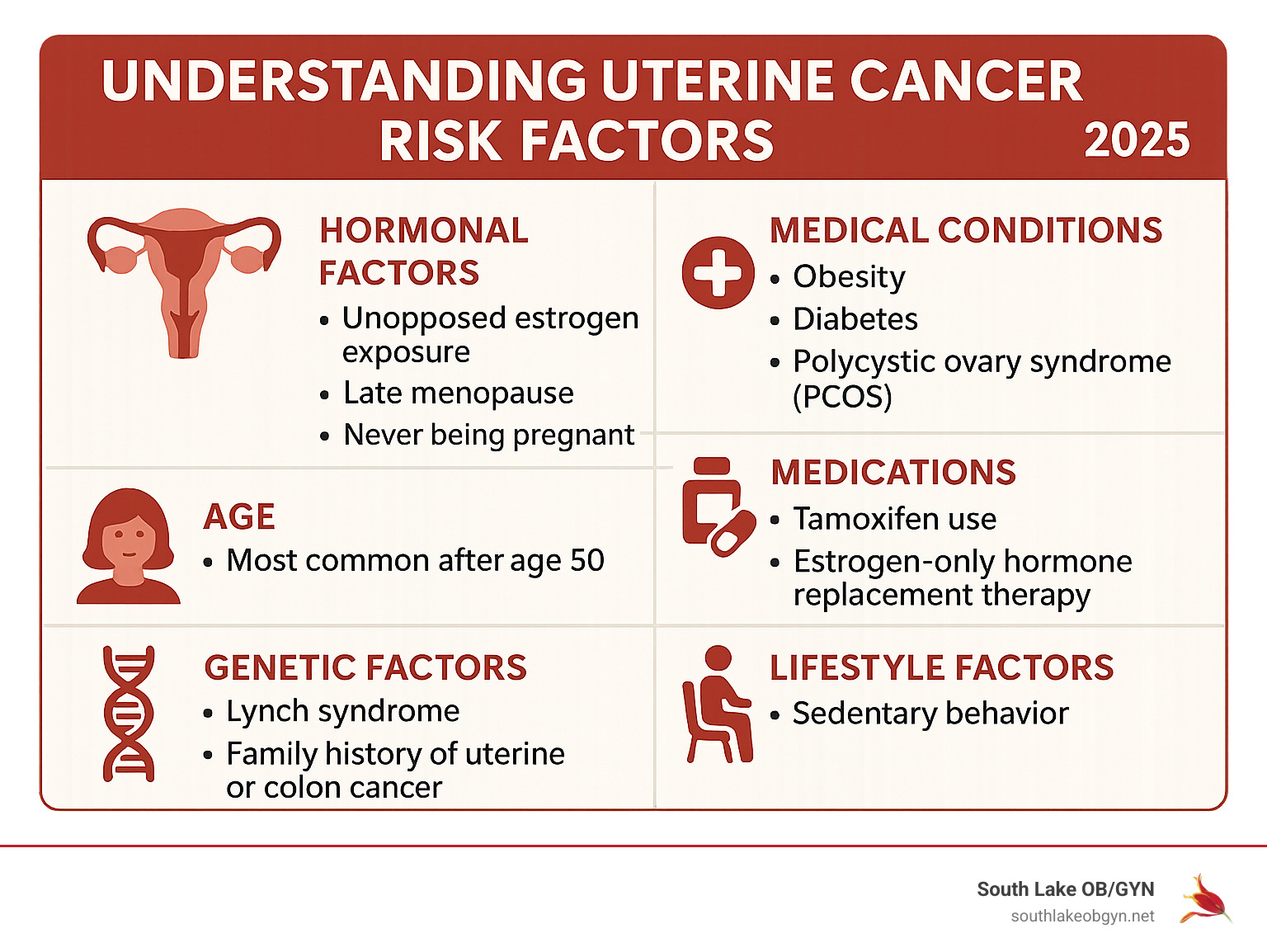
A comprehensive overview of the main risk factors for uterine cancer, organized by category
Understanding these factors doesn’t mean you’ll develop cancer – many women with risk factors never do. However, being informed helps you work with your healthcare provider to create a personalized prevention and screening plan.
At South Lake OB/GYN, we believe that understanding your individual risk profile is key to feeling more confident in making healthcare choices that support your long-term wellness. Our team, including Dr. Matthew Casavant, has spent over two decades helping women steer complex gynecological health decisions, including understanding and managing uterine cancer risk factors through preventive care and early detection strategies.
Uterine cancer risk factors basics:
The Role of Hormones and Reproductive Health
Your body’s hormonal balance plays a starring role when it comes to uterine cancer risk factors. Think of your uterus as being incredibly sensitive to the hormonal messages your body sends – especially estrogen and progesterone.
The endometrium (your uterine lining) responds to these hormones like a well-choreographed dance. Estrogen tells the lining to grow and thicken, while progesterone acts as the cleanup crew, helping to shed that lining during your period. When this partnership gets out of sync – particularly when estrogen takes the lead without enough progesterone to balance it out – problems can arise.

The health of the uterine lining (endometrium) is often influenced by hormonal balance.
Hormonal Imbalances and Their Link to Uterine Cancer Risk Factors
When we talk about “unopposed estrogen,” we’re describing a situation where estrogen is calling the shots without progesterone’s balancing influence. This can cause your endometrial lining to keep growing without the regular shedding that keeps things healthy.
Hormone Replacement Therapy (HRT) is one area where this balance becomes crucial. If you’re taking estrogen-only HRT after menopause and still have your uterus, your risk for uterine cancer increases significantly. That’s why doctors typically recommend combination HRT (estrogen plus progesterone) for women with a uterus – the progesterone helps protect against this risk.
Of course, every treatment has its trade-offs, and combination HRT comes with its own considerations, like potential impacts on breast cancer risk. This is exactly the kind of conversation worth having with your healthcare provider to weigh what’s right for your unique situation.
Polycystic Ovary Syndrome (PCOS) creates another hormonal challenge. Women with PCOS often don’t ovulate regularly, which means less progesterone production and more estrogen hanging around unchecked. The numbers are pretty striking – research shows that women with PCOS have nearly three times the risk of endometrial cancer, and for women under 54 with PCOS, that risk jumps even higher. The good news? Managing PCOS with progesterone therapy can help restore some balance. Scientific research on PCOS and cancer risk provides deeper insights into this connection.
Estrogen-producing ovarian tumors, while rare, can also tip the scales by flooding your system with extra estrogen. These tumors essentially create their own hormone factory, overstimulating the uterine lining.
The key takeaway? The longer your body is exposed to unopposed estrogen, the higher your risk becomes. This principle connects directly to your personal reproductive story.
Your Reproductive and Menstrual History
Your menstrual and reproductive journey creates a unique pattern of hormone exposure that influences your uterine cancer risk factors. Think of it as your body’s personal hormone timeline.
Starting your period early (before age 12) means you’ve been exposed to estrogen for more years of your life. While this slightly increases risk, it’s just one piece of a much larger puzzle.
Late menopause (after age 55) extends your natural estrogen production years. Research shows that women who go through menopause between ages 50-54 have about 22% higher risk if they’ve had children, and 34% higher risk if they haven’t, compared to women who reach menopause before 45.
Never having been pregnant is one of the more significant factors. Pregnancy is like giving your hormones a beneficial reset – progesterone levels stay high for months, giving your endometrium a break from constant estrogen stimulation. Women who’ve never given birth have roughly twice the risk of those who have had at least one full-term pregnancy.
Fertility challenges, especially when linked to irregular ovulation or hormonal imbalances, can create prolonged periods of unopposed estrogen exposure. This often overlaps with conditions like PCOS.
Your total number of menstrual cycles throughout your lifetime adds up too. More cycles mean more cumulative estrogen exposure, which without adequate progesterone balance, can contribute to increased risk.
Understanding these patterns helps you and your healthcare provider create a complete picture of your individual risk profile. Having risk factors doesn’t mean you’ll develop cancer – it simply means staying informed and proactive about your health makes good sense.
Key Medical and Lifestyle Uterine Cancer Risk Factors
Beyond hormones, our daily habits and existing health conditions significantly impact our risk of developing uterine cancer. Many of these uterine cancer risk factors are within our control, offering us powerful ways to reduce our personal risk.

- Alt text: Healthy lifestyle items including fresh vegetables, fruit, and exercise shoes.
- Caption: Lifestyle choices like diet and exercise play a significant role in managing uterine cancer risk.
- Filename: healthy-lifestyle-diet-exercise.jpg
How Weight, Diet, and Exercise Impact Your Risk
This is where our lifestyle choices truly shine (or, well, don’t). The connection between body weight, diet, and physical activity and uterine cancer risk factors is one of the most compelling and actionable areas for prevention.
- Obesity and Body Mass Index (BMI): This is perhaps the strongest and most preventable uterine cancer risk factor. Why? Because fat tissue, especially after menopause, can convert other hormones (androgens) into estrogen. The more fat tissue you have, the higher your estrogen levels, which fuels endometrial growth.
- Seven out of 10 uterine cancers are linked to excess fatty tissue.
- Women with BMIs between 25 and 29.9 (overweight) have double the risk compared to those with normal BMIs.
- Women with BMIs of 30 or above (obese) have three times the risk, and can be up to 10 times more likely to develop uterine cancer.
- The risk increases by 54% per 5-unit BMI increase, and 16% higher per 5 kg gained during adulthood.
- Even hip and waist circumference matter: 29% higher risk per 10cm increase in hip circumference, and 27% higher per 10cm increase in waist circumference.
- Weight cycling (repeatedly gaining and losing weight) is also linked to a higher risk of endometrial cancer after menopause.
- Sedentary lifestyle and Physical activity: Our bodies were made to move! Women who are not physically active have a higher risk of developing uterine cancer. Being active seems to protect against it, possibly by helping maintain a healthy weight, regulating hormone levels, and improving insulin sensitivity. Studies show a 15-27% lower risk in the most physically active women versus the least. Even small changes count: a 5% lower risk per 1 hour/week increment in leisure-time physical activity. Spending less time sitting also helps, with a 32% lower risk in women who spend the least time sitting versus those who spend the most.
- Diet: While a specific “high-fat diet” is mentioned, the general consensus points to a healthy, balanced diet. High-fat diets can contribute to obesity, which, as we’ve seen, is a major risk factor. Focusing on foods low in saturated fats, with plenty of fruits and vegetables, is crucial for overall health and cancer prevention. For comprehensive guidance on nutrition and physical activity, we recommend exploring the American Cancer Society Guidelines on Nutrition and Physical Activity.
Medical Conditions and Treatments to Be Aware Of
Several existing medical conditions and past treatments can also contribute to uterine cancer risk factors:
- Type 2 Diabetes: Women with type 2 diabetes are about 2 times more likely to develop uterine cancer compared to women without the disease. The risk is even higher if they are also obese or have high blood pressure, forming part of what’s called Metabolic Syndrome. This link is thought to be due to higher insulin levels (hyperinsulinemia) and insulin-like growth factors, which can promote cell growth.
- Endometrial hyperplasia: This is a precancerous condition where the lining of the uterus (endometrium) becomes too thick due to excessive cell growth. While simple hyperplasia has a low risk of becoming cancer, atypical hyperplasia, especially complex atypical hyperplasia (CAH), has a much higher chance (up to 29% if untreated). It’s crucial to treat this condition to prevent progression to cancer.
- Uterine polyps: While most uterine polyps are benign, they can sometimes contain cancerous or precancerous cells. Endometrial cancer occurs in 2-5% of cases among women with endometrial polyps, particularly in postmenopausal women.
- Tamoxifen use: This medication is a powerful drug used to treat or prevent breast cancer. While it acts as an anti-estrogen in breast tissue, it behaves like estrogen in the uterus, causing the uterine lining to grow. This leads to a small but increased risk of endometrial cancer, particularly in postmenopausal women who use it for two or more years. The risk is low (less than 1% per year), and the benefits for breast cancer prevention or treatment usually outweigh this rare risk. However, women taking tamoxifen should have yearly gynecologic exams and report any abnormal bleeding immediately.
- Prior pelvic radiation therapy: If you’ve received high-dose radiation therapy to the pelvic area for other cancers (like cervical or rectal cancer), it can slightly increase your risk of developing uterine cancer years later. This is particularly relevant for uterine sarcomas, a less common type of uterine cancer, which can develop 5 to 25 years after such treatment.
Here’s a concise list of medical conditions and treatments linked to higher uterine cancer risk factors:
- Polycystic Ovary Syndrome (PCOS)
- Type 2 Diabetes
- Endometrial hyperplasia (especially atypical)
- Estrogen-producing ovarian tumors
- Tamoxifen use (for breast cancer)
- Prior pelvic radiation therapy
- Metabolic syndrome (cluster of conditions including obesity, high blood sugar, high blood pressure)
- History of breast or ovarian cancer
Genetic Predispositions: Inherited Uterine Cancer Risk Factors
While most uterine cancers are sporadic (meaning they occur without a clear inherited cause), genetics do play a role in a small percentage of cases, accounting for about 5% of all uterine cancers. Understanding your family history can be a critical piece of your risk assessment.
- Lynch syndrome (Hereditary Nonpolyposis Colon Cancer or HNPCC): This is the most common inherited cause of uterine cancer. It’s a genetic disorder caused by defects in DNA repair genes (like MLH1, MSH2, MSH6, PMS2, EPCAM). Women with Lynch syndrome have a significantly liftd lifetime risk of developing uterine cancer, with some estimates as high as 70%. They also tend to develop it at a younger age. If you have a family history of colon or endometrial cancer, especially if diagnosed at a younger age, discussing genetic testing with your doctor or a genetic counselor is highly recommended. For more comprehensive information, you can refer to More on Lynch syndrome from the American Cancer Society.
- Cowden syndrome: This is another rare inherited condition linked to an increased risk of uterine cancer, along with other cancers like breast and thyroid cancer. It’s caused by mutations in the PTEN gene.
- BRCA genes: While primarily known for their link to breast and ovarian cancer, mutations in BRCA1 and BRCA2 genes have also been associated with a slightly increased risk of endometrial cancer.
If you have a strong family history of uterine, colon, or ovarian cancer, or if you’ve been diagnosed with Lynch or Cowden syndrome, our team at South Lake OB/GYN can help you explore genetic counseling and testing options. This information can guide personalized screening recommendations, such as annual endometrial biopsies starting at age 35 for individuals with a genetic risk, and even discussions about preventive surgeries like hysterectomy after childbearing is complete for those at very high risk.
Protective Factors and Reducing Your Risk
While many uterine cancer risk factors are beyond our control (like age or genetics), there are powerful proactive steps we can take to lower our personal risk. At South Lake OB/GYN, we’re all about empowering you with the knowledge and tools to take control of your gynecological health. We believe that understanding your body and making informed choices can truly make a difference.

- Alt text: A female patient having a positive consultation with her gynecologist.
- Caption: Openly discussing your health history with your doctor can help you identify ways to lower your risk.
- Filename: doctor-patient-gynecology-consultation.jpg
Proactive Steps to Lower Your Uterine Cancer Risk
The good news is that many of the healthy habits that benefit your overall well-being also play a big part in reducing your risk of uterine cancer. These are positive changes you can start making today!
Maintaining a healthy weight is one of the most impactful steps you can take. Obesity is a significant uterine cancer risk factor because excess fat tissue can produce estrogen, which encourages the uterine lining to grow too much. Aiming for a body mass index (BMI) below 25 is incredibly effective. Even preventing major weight gain as you get older can help reduce your risk. It’s truly a cornerstone of prevention.
Regular exercise is another powerful tool. Our bodies thrive on movement! Being physically active can significantly lower your risk, likely by helping you maintain a healthy weight, balancing your hormones, and improving how your body uses insulin. Studies show that women who are consistently active have a lower risk. So, whether it’s brisk walking, dancing, or hitting the gym, find what you love and keep moving! Even small increases in your activity can make a difference.
Did you know that oral contraceptives (birth control pills) can actually offer protection? Using birth control pills that contain both estrogen and progesterone for at least a year can lower your risk of endometrial cancer. This protective effect can even last for many years after you stop taking them. These pills work by creating a balanced hormonal environment that helps prevent the uterine lining from growing too much. Always chat with your provider about the best birth control options for you.
Intrauterine Devices (IUDs), both hormonal (progestin-releasing) and non-hormonal (copper), have also been linked to a decreased risk of endometrial cancer. The progestin in hormonal IUDs helps thin the uterine lining, offering a protective benefit.
Your pregnancy and breastfeeding history also matters. As we’ve learned, having children, especially multiple full-term pregnancies, can lower your risk. This is because pregnancy involves higher progesterone levels and fewer menstrual cycles, both of which protect the uterine lining. Breastfeeding offers even more protective advantages.
If you have Type 2 Diabetes, managing your blood sugar levels effectively is crucial. This can be done through diet, exercise, and medication if needed. Controlling diabetes helps reduce your uterine cancer risk factors, especially since it’s often linked with weight challenges.
Interestingly, some research suggests that regular coffee consumption (both caffeinated and decaffeinated) might offer a protective effect. Women who drink more coffee may have a lower risk compared to those who drink less. While we’re not suggesting you start drinking coffee just for this, it’s an intriguing finding!
Finally, paying attention to your body and getting prompt treatment for any abnormal bleeding or endometrial hyperplasia is vital. If you notice any unusual vaginal bleeding, especially between periods or after menopause, please see your doctor right away. This could be a sign of endometrial hyperplasia, which is a precancerous condition. Catching and treating it early can prevent it from progressing to uterine cancer. Early detection and intervention are truly key to your health.
By focusing on these proactive steps, you can significantly influence your personal risk profile. It’s all about making informed choices and partnering with your healthcare team to prioritize your well-being.
Frequently Asked Questions about Uterine Cancer Risks
We get a lot of questions from our patients about uterine cancer risk factors, and honestly, that makes us happy! Asking questions means you’re taking charge of your health. Let’s tackle some of the most common concerns we hear in our Clermont office.
How much does age increase my risk for uterine cancer?
Age is one of those uterine cancer risk factors that we can’t control, but understanding it helps put things in perspective. Most women diagnosed with uterine cancer are post-menopausal, with the average age of diagnosis around 60.
Think of it this way: the longer you live, the more estrogen exposure over time your body experiences. Before menopause, your ovaries produce both estrogen and progesterone in a careful dance. After menopause, progesterone production drops dramatically, but estrogen can still be produced by fat tissue. This creates an imbalance that can stimulate the uterine lining.
It’s not just about the hormones though. As we age, our cells have more opportunities to accumulate damage over the years. But here’s the thing – age alone doesn’t determine your destiny. Many older women never develop uterine cancer, while some younger women do. It’s really about your overall risk picture.
Are there racial or ethnic differences in uterine cancer risk?
This is such an important question, and the answer reveals some troubling healthcare disparities that we need to address honestly.
Higher incidence in White women is what the statistics show – they’re more likely to be diagnosed with uterine cancer overall. But here’s where it gets concerning: Black women face more aggressive types of uterine cancer. They’re more likely to develop harder-to-treat varieties like clear cell or serous carcinomas, which have poorer outcomes.
The disparities in diagnosis and outcomes are real and significant. Black and Hispanic women often face delays in diagnosis and have worse survival rates. This might be due to differences in healthcare access, but it could also reflect biological differences in how tumors develop.
Recent research has even suggested a possible link between chemical hair straighteners and increased endometrial cancer risk, particularly affecting Black women who use these products more frequently. It’s an area we’re watching closely as more research emerges.
These disparities remind us why personalized care and open communication are so crucial. At South Lake OB/GYN, we believe every woman deserves timely, thorough evaluation regardless of her background.
Can uterine cancer be prevented completely?
I wish I could give you a simple “yes,” but cancer prevention isn’t that straightforward. What we can talk about is risk reduction versus prevention – and there’s a big difference.
Many of the uterine cancer risk factors we’ve discussed are about lowering your odds, not eliminating them entirely. Maintaining a healthy weight dramatically reduces your risk, but it doesn’t make it zero. Taking birth control pills for several years can cut your risk in half, but again, not to zero.
Here’s what’s encouraging though: importance of awareness cannot be overstated. When you understand your personal risk factors, you can make informed decisions about your lifestyle and healthcare. You can have better conversations with your doctor about what makes sense for your situation.
Early detection is where we really shine. While there’s no routine screening test for uterine cancer like there is for cervical cancer, symptom recognition is incredibly powerful. The most important thing to remember? Any abnormal bleeding – especially after menopause or unusual bleeding between periods – needs to be checked out immediately.
When we catch uterine cancer early, before it spreads, the treatment success rates are excellent. Surgery can often cure it completely. That’s why we always tell our patients: don’t wait, don’t worry about “bothering” us, and don’t assume it’s nothing. Trust your instincts and call us.
Think of managing uterine cancer risk factors like maintaining your car. You change the oil, check the brakes, and drive carefully to reduce your risk of problems. You can’t prevent every possible issue, but you dramatically improve your odds of staying safe on the road.
Taking Control of Your Gynecological Health
You’ve just taken a big step by learning about uterine cancer risk factors. Knowing these can truly empower you to take charge of your health! Here at South Lake OB/GYN, located right in Clermont, FL, we’re dedicated to helping you steer your health journey with confidence. We’re here to provide the information, support, and personalized care you truly deserve.
We believe that great healthcare starts with a real connection. That’s why we strive to create a warm, family-like atmosphere where you feel comfortable asking anything and everything. Our team is eager to listen to your concerns, help you understand your unique risk profile, and then work with you to build a custom plan. This plan might include simple lifestyle recommendations, important screenings, or timely interventions – all designed to keep you healthy. Your well-being is our absolute top priority, and we want to make sure you feel supported and understood every single step of the way.
So, please don’t hesitate to chat with us about your uterine cancer risk factors or any other gynecological health questions you might have. We’re here to empower you with knowledge and provide the compassionate care that makes all the difference.