


Smooth Sailing: Tips for Managing Post-Hysterectomy Nausea
Navigating your recovery journey after a hysterectomy can be smoother with the right nausea management tips.
Understanding Post-Hysterectomy Nausea: What to Expect
Hysterectomy recovery and nausea often go hand in hand, leaving many women wondering if their queasy stomach is normal after surgery. The good news is that nausea is a common side effect that typically resolves within the first few days to weeks of recovery.
Common causes of post-hysterectomy nausea include:
- Anesthesia effects – lingering impacts from general anesthesia
- Pain medications – especially opioids which slow digestion
- Hormonal changes – particularly if ovaries were removed
- Slow digestion – constipation and gas buildup
- Overexertion – doing too much too soon during recovery
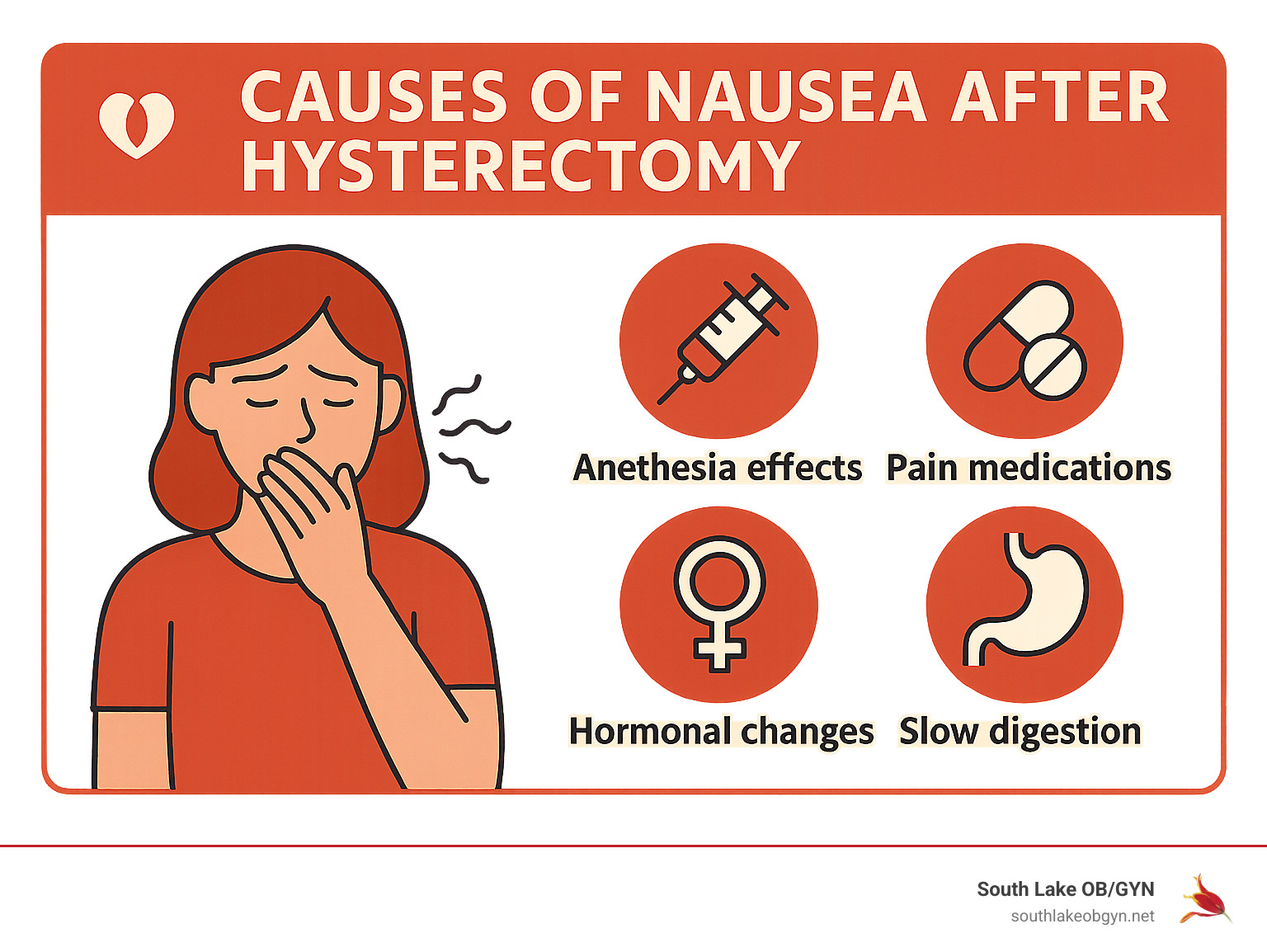
Common causes of nausea after hysterectomy surgery
Most women experience some degree of nausea in the first 24-48 hours after surgery, with symptoms gradually improving as the body heals. However, persistent or severe nausea may indicate complications that require medical attention.
As Dr. Matthew Casavant, I’ve guided countless women through their recovery journey and understand how concerning hysterectomy recovery and nausea can be during this vulnerable time. With over 20 years of experience in minimally invasive gynecologic surgery, I’ve seen how proper nausea management can make the difference between a difficult recovery and a smooth healing process.
Why Am I Feeling Nauseous After My Hysterectomy?
Feeling queasy after your hysterectomy? You’re definitely not alone. Hysterectomy recovery and nausea go together more often than most women expect, and there are several perfectly normal reasons why your stomach might be staging its own little rebellion right now.
Your body has just been through a major surgical event, and it’s responding in ways that might feel concerning but are actually quite common. Think of it like your body’s way of saying, “Hey, we need some time to get back to normal here!”

The complex relationship between your brain, gut, and hormones can all contribute to post-surgery nausea
Several things are happening in your body right now that can trigger nausea. The anesthesia effects from your surgery are still working their way out of your system, while pain medication side effects – especially from opioids – can slow down your digestion. Add in some hormonal fluctuations (particularly if you’re dealing with surgical menopause), plus the natural constipation that often follows surgery, and it’s no wonder your stomach feels unsettled.
Even overexertion can bring on waves of nausea. Your body is working hard to heal, and sometimes doing too much too soon can leave you feeling pretty rough. For more general information on hysterectomy, you can explore additional resources to understand what your body is going through.
The Role of Anesthesia and Pain Medication
Let’s start with the immediate culprit: general anesthesia. That medication that kept you comfortable during surgery doesn’t just disappear the moment you wake up. It lingers in your system and can cause what doctors call post-operative nausea and vomiting (PONV).
This is why you might have felt queasy right in the recovery room – it’s incredibly common. The good news is that we’re always prepared for this and have anti-nausea medications ready to help you feel better quickly.
Then there’s your pain medication. While those opioids are doing an important job managing your discomfort, they’re also notorious for causing opioid-induced nausea. These medications slow down your entire digestive system, which can leave you feeling sick to your stomach.
It’s all about finding the right pain management balance. We want to keep you comfortable without making you feel worse in other ways. That’s why it’s so important to tell us how you’re feeling – we can often adjust your medications or add something to help with the nausea while still keeping your pain under control.
How Hormones and Digestion Play a Part
Here’s where things can get a bit more complex. If you had your ovaries removed during your hysterectomy (ovary removal), you’ve been thrust into surgical menopause immediately, regardless of your age. This sudden drop in estrogen levels can trigger all sorts of symptoms, including nausea.
Even if your ovaries stayed put, they might be a little “shocked” from the surgery and not producing hormones as steadily as usual. Your body is essentially trying to figure out its new normal, and sometimes that process includes feeling queasy.
Your digestive system is also taking its sweet time getting back to work. Surgery causes slowed digestion – it’s like your gut decides to take a little vacation right when you need it most. This leads to gas and bloating, and there’s a definite constipation link to nausea that many women don’t expect.
When things aren’t moving through your system properly, that backed-up feeling can absolutely make you feel sick. It’s one of those domino effects where one issue leads to another, but the good news is that as your digestion gets back on track, the nausea usually improves too.
Overexertion can also trigger nausea during hysterectomy recovery and nausea management. If you’re feeling queasy along with increased pain or unusual discharge, your body might be telling you to slow down and rest more.
At-Home Strategies for Soothing Your Stomach
Now that you’re home and settling into recovery, you have more control over managing your hysterectomy recovery and nausea. The good news is that there are plenty of gentle, effective strategies you can use right from your own kitchen and living room. Think of this as your toolkit for feeling better – small changes that can make a big difference in how you feel each day.
Your stomach is likely still adjusting to everything that’s happened, so patience and gentleness are key. What worked for your appetite before surgery might not feel right just yet, and that’s completely normal. Let’s explore some practical ways to ease that queasy feeling and support your body’s healing process.
Diet and Hydration’s Role in Hysterectomy Recovery and Nausea
Your digestive system is working hard to get back to normal, so giving it the right fuel can make all the difference. Think of your stomach as being a bit sensitive right now – it needs foods that are easy to process and won’t cause additional upset.

A tray with bland foods like crackers, toast, broth, and a glass of water, symbolizing dietary choices for managing nausea during recovery.
Starting with bland, easily digestible foods is your best bet. The classic BRAT diet – bananas, rice, applesauce, and toast – has helped countless people through stomach troubles. These foods are gentle and unlikely to trigger more nausea. Plain crackers can be especially helpful when you first wake up, as they help settle your stomach before you even get out of bed.
Small, frequent meals work much better than trying to force down three large meals. Aim to eat something small every 2-3 hours rather than waiting until you’re really hungry. When your stomach is empty for too long, it can actually make nausea worse. Think of it as keeping your digestive system gently occupied rather than overwhelming it all at once.
Staying hydrated is crucial, but it can be tricky when you’re feeling nauseous. Sip clear liquids throughout the day – water, clear broths, and electrolyte solutions are excellent choices. If plain water feels too harsh, try it at room temperature or add a small slice of lemon. Aim for about 8-10 glasses of fluids daily, but don’t worry if you need to take it slowly.
To help you make the best choices, here’s a quick guide:
Foods to Try:
- Ginger and Peppermint: Try them as teas, or keep ginger chews on hand.
- Bland Proteins: Plain chicken breast, scrambled eggs.
- Simple Starches: White rice, toast, plain crackers.
- Cooked Vegetables: Steamed carrots are a gentle option.
- Clear Liquids: Clear broths and electrolyte drinks.
Foods to Avoid (for now):
- Spicy, Greasy, or Heavily Processed Foods: These can trigger more nausea.
- Acidic Foods: Citrus fruits and tomatoes might be too harsh.
- Certain Meats and Dairy: Red meat and most dairy (except plain yogurt) can be hard to digest.
- Gas-Producing Vegetables: Cruciferous vegetables like broccoli and cauliflower.
- Caffeine, Chocolate, and Carbonated Drinks: These can irritate a sensitive stomach.
Natural Remedies and Lifestyle Adjustments
Beyond what you eat, there are several gentle, natural approaches that can help ease your nausea and support your overall recovery. These remedies have been helping people feel better for generations, and many of our patients find them quite effective.
As mentioned, ginger and peppermint are two of nature’s best stomach soothers. Beyond drinking them as tea, even just inhaling the scent of peppermint oil can help calm your stomach.
Acupressure wristbands might look simple, but they can be surprisingly effective. These bands apply gentle pressure to a specific point on your wrist that’s believed to reduce nausea. They’re completely drug-free and can be worn all day without any side effects.
Deep breathing exercises can help calm both your mind and your stomach. When you feel nausea coming on, try slow, deep breaths through your nose, holding for a few seconds, then exhaling slowly through your mouth. This helps activate your body’s relaxation response and can reduce feelings of queasiness.
Gentle walking strikes the perfect balance between rest and movement during your hysterectomy recovery and nausea period. While overexertion can make nausea worse, gentle movement actually helps your digestive system get back on track. Start with short walks around your home or yard, gradually increasing the distance as you feel stronger. This movement also helps prevent blood clots and can improve your overall mood.
Prioritizing rest cannot be overstated. Your body is doing incredible healing work right now, and it needs energy for that process. Don’t feel guilty about taking naps or going to bed early. Fatigue is completely normal after major surgery and can last several weeks. When you’re well-rested, you’re better equipped to handle any nausea that comes your way.
Every woman’s recovery is different, so be patient with yourself as you figure out what works best for you. These strategies can significantly help manage your hysterectomy recovery and nausea, but don’t hesitate to reach out to our team if your symptoms persist or worsen.
When to Call Your Doctor About Nausea
While some degree of nausea is completely normal after a hysterectomy, there’s a fine line between expected discomfort and symptoms that need immediate attention. Think of me as your safety net – I’d much rather you call with a concern that turns out to be nothing than miss something important. Your peace of mind matters just as much as your physical healing.

A woman on the phone, looking concerned but calm, with a notebook, illustrating the importance of contacting your healthcare provider when symptoms are concerning.
Most women experience some queasiness in the first few days after surgery, and this typically gets better with time. However, hysterectomy recovery and nausea can sometimes signal that your body needs extra help or attention. Trust your instincts – you know your body better than anyone.
Severe or persistent nausea that doesn’t improve despite trying home remedies and medications is worth a phone call. If you’re feeling overwhelmed by queasiness that seems to be getting worse instead of better, don’t tough it out alone.
Vomiting that won’t stop is particularly concerning. If you can’t keep fluids or medications down for more than a few hours, you’re at risk for dehydration. This is especially serious because staying hydrated is crucial for healing.
Fever or chills combined with nausea can indicate an infection. Any temperature of 100.4°F (38°C) or higher deserves immediate attention, particularly when paired with feeling sick to your stomach.
Signs Nausea May Indicate a Complication
Sometimes nausea comes with other red flags that suggest something more serious is happening. Severe abdominal pain that’s not relieved by your prescribed pain medication, especially if it’s concentrated in one area, needs to be evaluated right away. While some discomfort is expected, pain that takes your breath away or keeps getting worse isn’t normal.
Heavy bleeding or foul-smelling discharge paired with nausea can signal internal bleeding or infection. Heavy bleeding means soaking through a pad every hour – that’s definitely not something to wait and see about.
Watch for signs of dehydration like excessive thirst, dry mouth, reduced urination, weakness, or feeling lightheaded. These symptoms can sneak up on you, especially when you’re already feeling unwell.
Problems with urination or bowel movements can also trigger nausea. If you haven’t had a bowel movement in five days or you’re having severe difficulty urinating, your body is telling you it needs help. Severe constipation can actually make nausea much worse.
I’ve seen patients whose nausea resurfaces weeks after surgery – sometimes around the 3 or 5-week mark – along with new symptoms like upper abdominal pain or burning sensations. This isn’t necessarily normal healing and deserves evaluation. Some complications, like cuff cellulitis, can cause nausea and dizziness around three weeks post-surgery and require antibiotic treatment.
For comprehensive recovery guidance, the ACOG guidance on hysterectomy recovery provides excellent additional information.
Discussing Anti-Nausea Medication with Your Provider
Here’s the thing about nausea medication – we have excellent options available, but I need to know what you’re experiencing to help you effectively. Don’t suffer in silence when relief might be just a phone call away.
When you reach out to discuss your hysterectomy recovery and nausea, I’ll want to understand the full picture. How severe is your nausea on a scale of 1 to 10? Is it constant or does it come and go? Does it happen only after eating, or does movement make it worse?
Tell me what you’ve already tried – the ginger tea, crackers, small meals, or any over-the-counter remedies. This helps me understand what’s working and what isn’t. I also need to know about any other symptoms you’re experiencing, like pain levels, fever, dizziness, or constipation issues.
Prescription antiemetics work through different pathways in your body to stop nausea at its source. Some target the brain’s nausea center, while others work on your digestive system. The key is finding the right one for your specific situation.
Sometimes the solution is adjusting your pain medication rather than adding another drug. If your current pain relievers are causing significant stomach upset, we might switch to a different type, reduce the dosage, or combine medications in a way that gives you comfort without the queasiness.
Effective pain management and nausea control work hand in hand. When you’re not fighting constant queasiness, you can rest better, eat properly, and heal more comfortably. That’s exactly what we want for your recovery at South Lake OB/GYN.
Frequently Asked Questions about Hysterectomy Recovery and Nausea
I know you have many questions swirling around in your mind as you steer your hysterectomy recovery and nausea. After guiding countless women through this journey, I’ve heard these concerns time and time again. Let me address the questions that come up most often in our recovery conversations.
How long does nausea typically last after a hysterectomy?
The timeline for nausea after a hysterectomy is as unique as you are, but there are some general patterns I’ve observed over my years of practice. The most intense wave of nausea usually hits in those first 24 to 48 hours after surgery – this is your body’s way of processing the anesthesia. You might wake up feeling groggy, uncomfortable, and yes, quite queasy. This is completely normal, and our recovery room nurses are experts at helping you through this phase with anti-nausea medications.
The lingering queasiness that follows is often tied to your pain medications and your digestive system getting back into rhythm. This typically improves within the first week, though some women experience occasional waves of nausea for up to two or three weeks. I’ve had patients tell me they felt great for a while, then suddenly felt nauseous again around the 3-week mark – this can happen and usually resolves quickly.
Here’s when I want you to call us: if your nausea persists beyond a few weeks or if it suddenly returns after you’ve been feeling well (some patients report this happening around 5 weeks post-op). Individual recovery variation is real – some women bounce back quickly while others need a bit more time, and both are perfectly normal.
Can the type of hysterectomy I had affect my chances of feeling nauseous?
Absolutely, and this is such an insightful question. The surgical approach we used for your hysterectomy does influence how you might experience nausea during recovery.
If you had an abdominal hysterectomy, you underwent a more extensive procedure with a larger incision. This typically means a longer time under anesthesia and more surgical manipulation of your internal organs. The result? You might experience more pronounced nausea that lasts a bit longer. You’ll also be staying with us for two or three days, which gives us more time to manage your comfort.
Laparoscopic hysterectomy, including our robotic-assisted procedures, tends to be gentler on your system. With smaller incisions and less internal manipulation, many of my patients find their nausea resolves more quickly. You’ll likely go home the same day or the next morning, feeling more like yourself sooner. Even our laparoscopic supracervical hysterectomy patients often have remarkably smooth recoveries, sometimes feeling back to normal within 6 days to 2 weeks.
Vaginal hysterectomy is often the smoothest ride of all. Since we remove your uterus through the vagina without any abdominal incisions, there’s typically less trauma to your digestive system. Many women are surprised by how quickly they feel better – often going home the next day with minimal nausea.
That said, any hysterectomy can cause some queasiness due to anesthesia and pain medications, regardless of the approach. The beauty of modern surgical techniques is that we can often minimize these side effects while ensuring your complete healing.
What are the long-term implications of persistent nausea after a hysterectomy?
Let me put your mind at ease right away: persistent nausea is uncommon and is not a normal long-term consequence of hysterectomy. When it does occur beyond the typical few weeks of recovery, it usually signals something specific that we can identify and address.
If you’re dealing with ongoing nausea weeks after your surgery, we’ll work together like detectives to figure out what’s happening. Sometimes it’s related to gastrointestinal changes – perhaps your digestive system is still adjusting, or in rare cases, there might be a bowel issue that needs attention. Other times, it could be connected to hormonal fluctuations, especially if we removed your ovaries and you’re adjusting to hormone replacement therapy.
The importance of follow-up care cannot be overstated. I always tell my patients that persistent symptoms are your body’s way of asking for help. We might need to review your medications, check for any signs of infection, or explore whether other medical conditions might be contributing to your discomfort.
What I want you to remember is this: you don’t have to suffer through persistent nausea thinking it’s “just part of recovery.” At South Lake OB/GYN, we’re committed to your complete healing and well-being. If something doesn’t feel right, we’ll keep investigating until we find answers and get you feeling like yourself again.
Your Path to a Comfortable Recovery
Your journey through hysterectomy recovery and nausea doesn’t have to be overwhelming. While it might feel daunting right now, thousands of women have walked this path before you and emerged stronger on the other side. Most importantly, you have a dedicated team at South Lake OB/GYN cheering you on every step of the way.
Patience with healing is perhaps the most valuable gift you can give yourself right now. Your body has just undergone major surgery, and it’s working incredibly hard behind the scenes to repair and restore itself. Some days will feel better than others, and that’s completely normal. Think of recovery as a gentle wave rather than a straight line upward – there will be ups and downs, but the overall trend is toward feeling better.
Listening to your body becomes your superpower during this time. When you feel that familiar wave of nausea creeping in, it might be your body’s way of saying “slow down” or “try something different.” Maybe it’s time for some ginger tea, a short walk around the block, or simply putting your feet up for a bit. Your body has an amazing ability to communicate what it needs – you just need to tune in and trust those signals.
The proactive management strategies we’ve discussed aren’t just suggestions – they’re your toolkit for taking control of your recovery. Whether it’s sipping on clear broth, trying those acupressure wristbands, or sticking to bland foods for a few more days, each small step you take is an investment in feeling better. Some remedies might work better for you than others, and that’s perfectly fine. Recovery is deeply personal.
Open communication with our team makes all the difference in your healing journey. We’ve seen it all, and there’s no question too small or concern too minor. Whether you’re wondering if that wave of nausea at week three is normal or you need reassurance about your progress, we’re here with answers and support. At South Lake OB/GYN, we believe that informed patients heal better and faster.
Our practice in Clermont, FL, isn’t just about medical expertise – it’s about creating that family-like atmosphere where you feel heard, understood, and genuinely cared for. We know that personalized care means recognizing that your recovery is unique to you, and we’re committed to adjusting our approach to match your specific needs and concerns.
Your hysterectomy recovery and nausea experience is temporary, but the strength and knowledge you gain from navigating it will stay with you. We’re honored to be part of your healing journey and look forward to celebrating your full recovery with you.