

An Introduction to OB/GYN Compensation
Caption: Understanding OB/GYN compensation helps healthcare professionals and patients alike
Obstetrics and gynecology salary is a topic that matters to medical students, practicing physicians, and anyone curious about the financial side of women’s healthcare. Whether you’re considering a career in this field or simply want to understand what your doctor earns, knowing the numbers helps.
Quick Answer: What Do OB/GYNs Make?
- National Average: $278,660 per year (2023 BLS data)
- Entry-Level: $200,000 – $220,000 annually
- Experienced Physicians: $380,000 – $450,000+ per year
- Top-Paying States: Washington ($364,060), Connecticut ($353,750), Colorado ($353,190)
- Resident Salary: Approximately $60,564 per year
The financial landscape for obstetrics and gynecology continues to evolve. Recent data shows steady salary growth, with projections suggesting OB/GYN salaries could reach $380,000 to $420,000 by 2025. But compensation isn’t just about base salary—it’s influenced by experience level, geographic location, practice setting, and even factors like malpractice insurance costs.
Obstetrics focuses on pregnancy and childbirth, while gynecology centers on women’s reproductive health. Together, these specialties form a demanding but rewarding career path that requires years of training and dedication.
This article breaks down everything you need to know about OB/GYN compensation—from national averages to regional variations, and from entry-level earnings to what experienced physicians can expect.
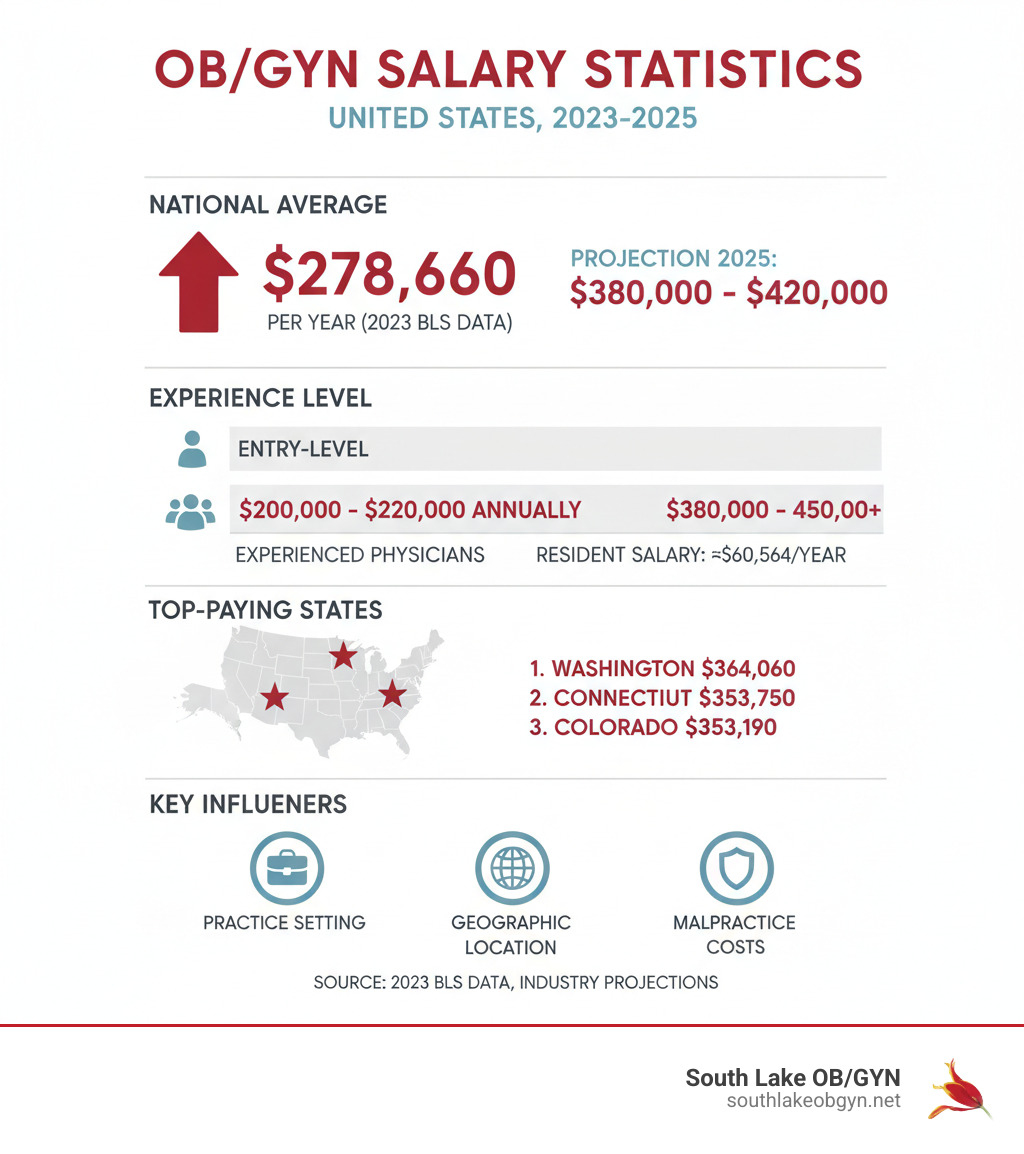
Caption: Key salary statistics for obstetrics and gynecology physicians in the United States
I’m Dr. Matthew Casavant, founding physician of South Lake OB/GYN with over 20 years of experience in obstetrics and gynecology. Throughout my career, I’ve seen how obstetrics and gynecology salary varies based on practice setting, location, and expertise, and I’m here to help you understand what drives these differences.
The National OB/GYN Salary Landscape
When considering a career in obstetrics and gynecology, it helps to understand the full financial picture.
According to the official BLS salary data for OB-GYNs, the mean annual wage for obstetricians and gynecologists was $278,660 as of May 2023, a figure reflecting the specialty’s demanding nature.
The median salary, which can be a better indicator of a “typical” wage, was $239,200 in 2023. As the midpoint, it isn’t skewed by extremely high earners.
The salary spread is worth noting. The highest-paid 25% of OB-GYNs earned $239,200 or more in 2023, while the lowest-paid 25% made around $186,290. This significant difference is influenced by location, experience, and practice setting—more on that later.
During the crucial training period of residency and fellowship, the average resident and fellow salary is around $60,564 per year. These years are essential for building the skills that define a career.
A quick clarification: an obstetrician specializes in pregnancy and childbirth, while a gynecologist focuses on women’s reproductive health. Most physicians are board-certified in both areas, working as full OB-GYNs. If you’re curious about the nuances, our page on Ob-Gyn vs. Gynecologist breaks it down further.
So how does the obstetrics and gynecology salary compare to other medical specialties? OB-GYNs sit comfortably in the upper tier of physician compensation. Surgeons, for instance, averaged $348,890 in 2023, reflecting their intensive surgical focus. General physicians earned around $263,840, placing OB-GYNs notably ahead.
Pediatricians, who focus on children, made an average of $205,860—about $70,000 less than OB-GYNs. Nurse midwives earned an average of $131,570. These comparisons highlight that OB-GYNs command strong compensation that reflects their extensive training, work complexity, and critical role in women’s healthcare.
The bottom line is that the obstetrics and gynecology salary landscape is robust, with earning potential that rewards the years of training and demanding hours of the specialty.
Key Factors That Influence an OB/GYN’s Salary

Caption: Effective negotiation is key to maximizing an OB/GYN’s compensation package.
The average obstetrics and gynecology salary is just a starting point. An individual OB/GYN’s earnings can vary by hundreds of thousands of dollars based on several factors. Your take-home pay depends on your location, experience, and deductions from your paycheck. Understanding these factors is essential for career planning and contract negotiation, as the total compensation package is more important than base salary alone.
Experience Level: From Entry-Level to Senior Physician
Experience is a key driver of salary. While new graduates have strong earning potential, it takes time to reach the upper ranges.
An entry-level salary is typically $200,000 to $220,000 annually, with some new OB-GYNs earning around $227,351. This foundation year is for building a patient base and refining skills. If you’re searching for your first position, especially in Central Florida, our guide on Finding the Right ObGyn in Clermont can help you understand what makes a supportive practice environment.
Mid-career earnings for physicians with 5-9 years of experience climb to around $260,000 per year. At this stage, you’re handling more complex cases and have built trust in your community.
For experienced OB/GYN physicians with a decade or more of practice, the numbers get even better. Senior physicians average $319,460 annually, with many earning $400,000 to $450,000 or more, especially those with 20+ years of experience. This reflects clinical expertise, established patient relationships, and leadership roles.
The salary progression over time is clear: stick with it, keep learning, and your earning potential grows substantially.
Practice Setting and Employment Type
Where you work shapes your paycheck almost as much as how long you’ve been practicing. Each setting offers different advantages and trade-offs.
Hospital-employed positions offer stability, a steady salary, and benefits, with the hospital handling administrative tasks like billing and malpractice insurance. This allows physicians to focus on patient care, though the salary might be capped compared to private practice.
Private practice ownership offers the highest income potential, as you directly benefit from patient volume and efficiency. However, this comes with significant overhead costs like rent, staff salaries, and equipment, plus all administrative duties. It’s entrepreneurship meets medicine—rewarding but demanding.
Academic medical centers attract physicians who love teaching and research. Salaries here might be slightly lower than in purely clinical roles, but you gain intellectual stimulation and opportunities for professional growth.
While permanent roles provide long-term stability, some physicians explore locum tenens positions—temporary contracts that fill staffing gaps. These can pay significantly more per hour and offer flexibility. The average salary including locum tenens work reached approximately $367,000 in 2024, showing how these roles can boost overall earnings.
At South Lake OB/GYN, we focus on providing Comprehensive Gynecological Care through a stable, dedicated team. We’ve found that continuity of care creates the best outcomes for our patients and the most satisfying work environment for our physicians.
How Deductions Impact Take-Home Obstetrics and Gynecology Salary
Your gross salary and net income are two very different numbers.
Malpractice insurance costs are especially high for OB-GYNs due to the high-stakes nature of the specialty. Premiums can range from $50,000 to over $100,000 annually, depending on your state and claims history.
State and federal taxes take another massive bite. As a high earner, you’re looking at combined tax rates of 30-40% or more between income tax, Social Security, and Medicare.
Other necessary deductions include retirement contributions and health insurance premiums, which can run thousands per month if not fully covered by your employer.
Don’t forget professional expenses like medical licensing fees, continuing education, and society memberships. For many OB-GYNs, student loan repayments also represent a substantial monthly commitment.
When you add it all together, that impressive obstetrics and gynecology salary might shrink by 40-50% or more before reaching your bank account. Understanding the difference between gross and net income is crucial for financial planning and salary negotiation.
Geographic Variations in Obstetrics and Gynecology Salary

Caption: A visual representation of states with high OB/GYN salaries across the USA.
Your practice location is as important as your specialty when it comes to your obstetrics and gynecology salary. A higher salary in a major city may be offset by a higher cost of living. In contrast, some rural communities offer attractive packages, including loan repayment or signing bonuses, to draw physicians to underserved areas, making the total compensation very competitive.
The urban versus rural question isn’t always straightforward. While major metropolitan areas typically show higher nominal salaries, the financial picture changes when you factor in the cost of living. Some rural areas, especially those designated as medically underserved, attract OB-GYNs with creative compensation packages that can result in a better quality of life and more take-home pay.
At South Lake OB/GYN in Clermont, we’ve found a sweet spot—a growing community with strong healthcare needs and a cost of living that lets our physicians enjoy their hard-earned income.
Highest-Paying States and Cities for OB/GYNs
If you’re curious about where OB-GYNs earn the most, the data tells an interesting story.
Washington leads with an average salary of $364,060, thanks to its investment in women’s health services and Medicaid expansion. Connecticut follows at $353,750, and Colorado is third at $353,190, attracting physicians with its focus on maternal health initiatives.
North Dakota might surprise you at $349,380, followed by Indiana at $331,870. These states have worked to create physician-friendly environments with lower overhead costs.
Other high-paying states include Delaware ($285,767), which has implemented progressive women’s health policies; Illinois ($283,117), benefiting from respected medical institutions; New York ($281,407); and Virginia ($281,169), boosted by its growing emphasis on rural healthcare.
Maryland ($276,641) boasts top institutions like Johns Hopkins Hospital. Vermont ($275,264) has an innovative healthcare system. Nebraska ($270,402) offers a low cost of living, and Missouri ($269,606) sees high demand in rural communities.
When we zoom in on specific metropolitan areas, Springfield, IL leads the pack at an impressive $441,240. Seattle, WA offers $380,480, while Chattanooga, TN comes in at $368,360. St. Louis, MO averages $360,740, and San Jose, CA rounds out the top five at $356,760.
The average obstetrics and gynecology salary in New York, NY is $291,162 per year—about 6% above the national average, driven by the high cost of living.
Here in Florida, the landscape is different. The average salary for an obstetrics and gynecology physician in Florida was $249,380 as of May 2019. While this might seem lower, Florida offers no state income tax, a lower overall cost of living in many areas, and a growing population that creates steady demand. For those of us practicing in the Orlando area, including Clermont, we see The Importance of Seeing an ObGyn in Orlando and the surrounding communities.
Understanding Regional Demand and Healthcare Initiatives
These salary differences are driven by what’s happening on the ground in these states and communities.
State health policies directly shape OB-GYN compensation. For instance, Washington and Colorado’s investments in women’s health services and Medicaid expansion have increased patient demand and reimbursement rates, boosting salaries for qualified OB-GYNs.
Delaware has taken a particularly progressive approach to women’s health policies, focusing on reducing maternal mortality rates and increasing prenatal care access. This positions OB-GYNs at the center of meaningful work while supporting competitive compensation.
Physician wellness programs are another emerging trend. Washington’s “Quadruple Aim” initiative, for example, focuses on improving the quality of life for healthcare clinicians, making the state more attractive for building a career.
Rural healthcare needs are creating unique opportunities. Nebraska and Missouri have bolstered their rural residency programs and offer loan repayment incentives to attract physicians to underserved areas. For new graduates facing substantial student loan debt, these programs can be life-changing.
The growing emphasis on What is Preventive Medicine? is reshaping how OB-GYNs practice. States that prioritize preventive care and maternal health initiatives create stable, growing environments for physicians, often with value-based payment models that reward quality care.
At the end of the day, the best location for your OB-GYN career depends on more than just the salary number. It’s about finding a place where the compensation, cost of living, practice environment, and personal lifestyle preferences all align.
The Future Outlook for OB/GYN Salaries
The financial future for OB-GYNs looks bright. If you’re considering this specialty or already practicing in the field, the salary trends over the next few years should give you reason to be optimistic.
By 2025, the average obstetrics and gynecology salary is projected to reach between $380,000 and $420,000 annually. That’s a significant jump from current averages. For experienced professionals with established practices and specialized skills, earnings could climb even higher—potentially reaching $450,000 or more by 2025. Even those just starting out can expect improved compensation, with entry-level positions possibly starting around $220,000 by 2025. The OBGYN Salary Report and 2025 Outlook from AMN Healthcare provides detailed projections that support these encouraging numbers.
What’s driving this upward trend? Several key factors are at play.
Market demand remains strong and is expected to grow. The nation faces a recognized shortage of OB-GYNs, particularly in rural and underserved areas. As the population continues to grow and age, the need for comprehensive women’s healthcare services will only increase. This supply-and-demand dynamic naturally pushes salaries upward as healthcare systems compete to attract and retain qualified physicians.
The impact of telehealth is reshaping how OB-GYNs deliver care. Virtual consultations, remote monitoring for prenatal patients, and digital follow-up appointments are expanding access to care beyond traditional office visits. This technology allows physicians to see more patients efficiently, extend their reach to underserved areas, and create new revenue opportunities—all of which can positively impact overall compensation.
Healthcare’s shift toward value-based care models is also influencing the salary landscape. Rather than simply paying for the volume of services provided, these models reward physicians for patient outcomes, preventive care, and overall quality of care. OB-GYNs who excel at keeping patients healthy, reducing complications, and providing exceptional care will increasingly see this reflected in their compensation packages. Understanding the Obstetrics and Gynecology Meaning in today’s healthcare environment means recognizing this shift toward outcomes-based medicine.
Technology continues to advance at a rapid pace, too. Minimally invasive surgical techniques, improved diagnostic tools, and better monitoring systems allow OB-GYNs to provide higher-quality care more efficiently. These advancements not only improve patient experiences but also improve a physician’s ability to manage a robust practice.
The combination of these factors—sustained demand, technological innovation, and evolving payment models—creates a favorable environment for OB-GYN compensation growth. For those of us passionate about women’s health, it’s encouraging to see that the vital services we provide will continue to be recognized and valued, both professionally and financially, in the years ahead.
Frequently Asked Questions about OB/GYN Salaries
Navigating the financial aspects of a career in obstetrics and gynecology can bring up many questions. Here, we address some of the most common inquiries about the obstetrics and gynecology salary to provide clarity.
What is a typical starting salary for a new OB/GYN?
A new OB/GYN’s typical starting salary is $200,000 to $220,000 annually. Some reports show an average of around $227,351 for those with less than one year of experience.
This is a significant jump from the average resident salary of $60,564. This initial phase is focused on building a patient base and refining clinical skills developed during training.
Several factors can influence first-year earnings, including geographic location, practice setting, and negotiation skills during the first contract discussion.
How does an OB/GYN’s salary compare to a pediatrician’s?
OB/GYNs typically earn more than pediatricians. In 2023, the average OB/GYN salary was $278,660, while the average pediatrician salary was $205,860.
This difference of roughly $70,000 reflects several factors. OB/GYN work includes a surgical component (e.g., C-sections, hysterectomies) and demanding on-call schedules, as emergencies can happen at any hour.
The specialized nature of the training, which combines medical and surgical skills for high-risk situations, also contributes to the higher compensation compared to other important specialties.
Do OB/GYNs who own their practice make more money?
This is a nuanced question. Private practice ownership can offer the highest income potential, but it’s not a guarantee of more take-home pay.
Historically, private practice owners have had higher earning potential because they benefit directly from patient volume and billing efficiency. Successful owners can earn significantly more than their hospital-employed counterparts.
However, ownership comes with substantial overhead (rent, staff, equipment) and administrative duties that reduce gross income. Owners are also responsible for marketing, malpractice insurance, and bear all financial risk.
The time commitment for administrative tasks is another consideration. Hospital employment offers a different value proposition. While the base salary might be lower, hospital-employed OB-GYNs enjoy more stability, comprehensive benefits, a reduced administrative burden, and the hospital typically covers malpractice insurance. For many physicians, these benefits outweigh the potential for higher income.
At South Lake OB/GYN, we understand that the best practice setting aligns with your personal and professional goals. What matters most is finding an environment where you can provide excellent care while maintaining your own well-being.
Maximizing Your Career and Compensation
Understanding the ins and outs of obstetrics and gynecology salary goes beyond memorizing statistics—it’s about making smart choices that support both your bank account and your well-being. After exploring everything from national averages to regional variations, let’s bring it all together with practical insights for building a rewarding career.
The salary drivers we’ve covered tell a clear story. Your earning potential grows substantially with experience, jumping from around $200,000 as a new graduate to potentially $450,000 or more after two decades in practice. Geography plays a powerful role too—Washington state’s average of $364,060 looks quite different from other regions, though remember to factor in living costs when comparing numbers. Your practice setting matters tremendously, whether you’re drawn to the stability of hospital employment, the autonomy of private practice, or the flexibility of locum tenens work.
But here’s what we’ve learned after years of caring for patients: career satisfaction isn’t just about the paycheck. Yes, financial security matters—especially when you’re paying off medical school loans and hefty malpractice insurance premiums. Yet the most fulfilled OB-GYNs we know are those who find meaning in their daily work, who build lasting relationships with patients, and who feel supported by their colleagues.
At South Lake OB/GYN in Clermont, FL, we’ve built our practice around this philosophy. Our commitment to open communication, personalized care, and creating a family-like atmosphere isn’t just good for patients—it creates a fulfilling environment where healthcare professionals can thrive. We believe that when you feel valued and supported in your work setting, that positive energy flows through to everyone you care for.
Professional growth keeps your career fresh and your compensation competitive. Stay current with evolving healthcare models like telehealth and value-based care. These aren’t just buzzwords—they’re reshaping how OB-GYNs practice and get paid. Invest in continuing education, consider subspecialty training if it interests you, and don’t shy away from negotiating your compensation package. Your total package includes salary, benefits, malpractice coverage, retirement contributions, and work-life balance.
The future looks bright for this specialty. With projections suggesting salaries could reach $380,000 to $420,000 by 2025, and with the ongoing demand for women’s healthcare services, you’re entering or continuing in a field that values your expertise. Whether you’re a medical student weighing your options or an established physician considering a change, the financial outlook remains strong.
Ready to explore more about this dynamic field? Learn more about Obstetrics and Gynecology Salary and find how you can build a career that’s both financially rewarding and personally meaningful. After all, the best compensation package includes not just dollars, but also the satisfaction of making a real difference in women’s lives every single day.