


How to Check Fertility
- Alt text: A woman at home reviewing her cycle dates and ovulation tests—header image for how to check fertility.
- Caption: Start here: a simple, confidence-building overview of how to check your fertility at home and with a specialist.
- Filename: how-to-check-fertility-header.jpg
Why Understanding How to Check Fertility Matters Now
How to check fertility starts with understanding where you are in your reproductive health journey. Whether you’re actively trying to conceive, planning for a future family, or simply curious about your reproductive wellness, knowing your fertility status puts you in control.
Quick Answer: How to Check Fertility
- Track your menstrual cycle – Monitor cycle length and regularity (26-36 days is typical)
- Use at-home ovulation tests – Detect your LH surge to identify fertile days
- Try at-home hormone tests – Measure AMH and FSH levels for ovarian reserve insights
- Monitor physical signs – Track basal body temperature and cervical mucus changes
- See a fertility specialist – Get comprehensive testing if you’re under 35 and trying for 1 year, or over 35 and trying for 6 months
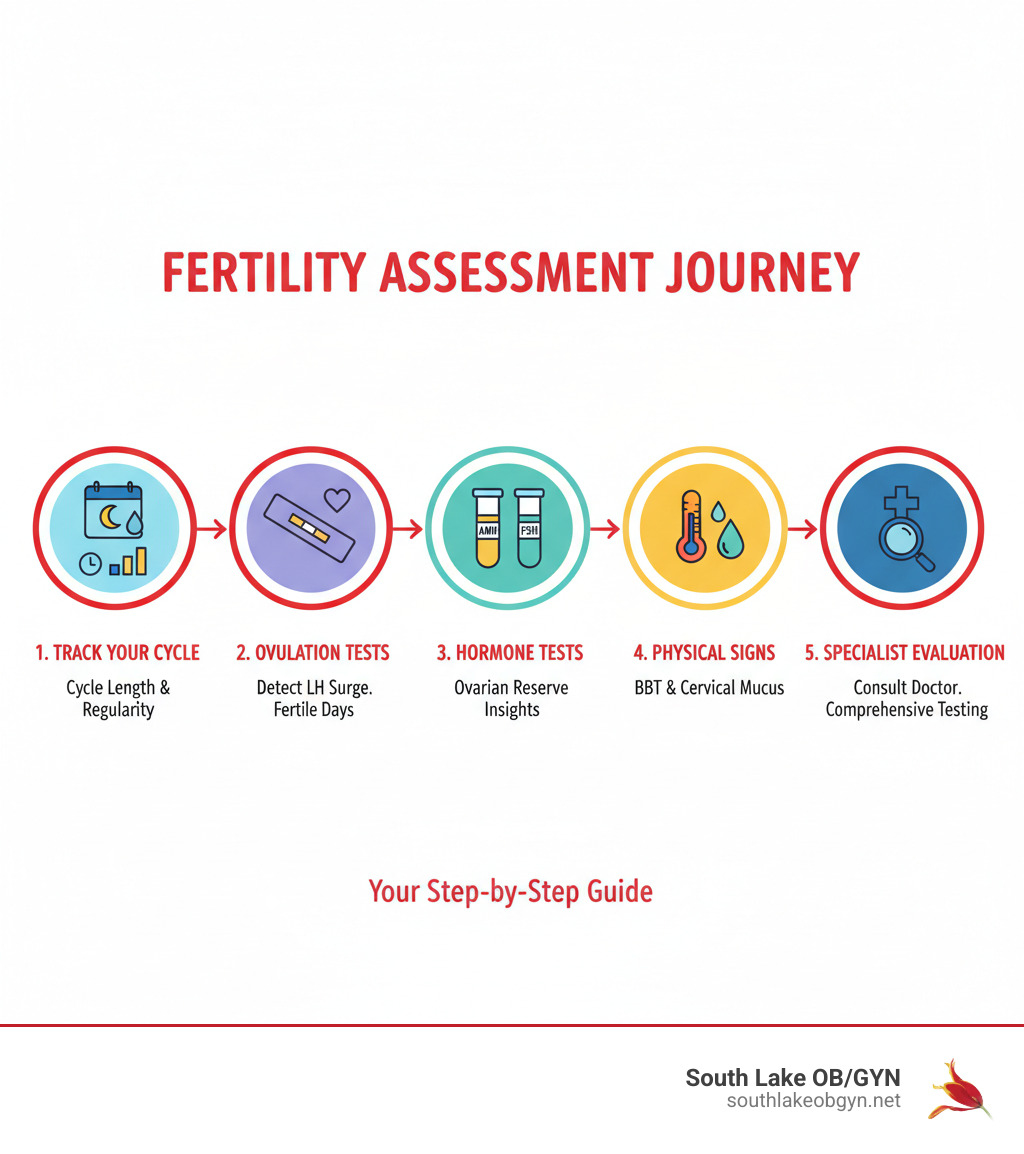
Caption: Your step-by-step guide from initial tracking to professional evaluation
Filename: fertility-check-journey-infographic.png
For many couples, pregnancy happens naturally within the first year of trying. More than 8 in 10 couples where the woman is under 40 will conceive naturally within a year of having regular unprotected sex. But what if you’re in the group that doesn’t? Or what if you simply want to be proactive about understanding your reproductive health before you start trying?
The good news is that checking your fertility has never been more accessible. You have options ranging from simple cycle tracking to sophisticated at-home tests to comprehensive clinical evaluations. Each approach offers different insights, and knowing which path is right for you depends on your age, health history, and personal circumstances.
This guide breaks down everything you need to know about how to check fertility in clear, actionable steps. We’ll walk you through at-home methods you can start today, explain when it’s time to see a specialist, and explain the clinical tests that provide the most complete picture of your reproductive health.
As Dr. Matthew Casavant, founding physician of South Lake OB/GYN, I’ve spent over two decades helping women understand how to check fertility and guiding them through their reproductive health journeys with compassion and evidence-based care. Whether you’re just starting to explore your options or ready for a comprehensive evaluation, I’m here to help you make informed decisions about your fertility with confidence.
When to Consider Fertility Testing
Deciding when to seek answers about your fertility is personal, but medical guidelines can help you time your decision. Age is a key factor, as female fertility naturally declines over time, making a proactive approach beneficial.

- Alt text: A woman discussing her fertility concerns with a compassionate doctor at South Lake OB/GYN.
- Caption: Knowing when to talk to a specialist can make all the difference in your fertility journey.
- Filename: when-to-get-fertility-test.jpg
General Timelines for Seeking Help
While many couples under 40 conceive within a year, patience isn’t always the best strategy. According to the American College of Obstetricians and Gynecologists (ACOG), the standard recommendations are:
- If you’re under 35: Seek a fertility evaluation after one full year of trying to conceive.
- If you’re 35 or older: Schedule a consultation after six months of trying.
Starting the evaluation process earlier for those over 35 accounts for the natural age-related decline in fertility and ensures you don’t lose valuable time if treatment is needed.
For more detailed guidance on timing your consultation, read our article: When Should You See an Infertility Specialist?
Health Indicators for Earlier Evaluation
Certain health conditions warrant a fertility evaluation sooner, sometimes even before you start trying. Consider these red flags for an earlier conversation with your doctor:
- Irregular menstrual cycles: If your periods are unpredictable, absent, or more than 35 days apart, you may have an ovulatory disorder.
- History of Pelvic Inflammatory Disease (PID): PID can cause scarring in the fallopian tubes, creating a physical barrier to conception.
- Repeated miscarriages: Two or more consecutive pregnancy losses suggest an underlying cause that needs investigation.
- Known endometriosis or PCOS: These conditions can affect ovulation, the ovaries, and fallopian tubes, and benefit from early intervention.
- Previous cancer treatment: Chemotherapy or radiation can impact fertility, so a consultation before trying is crucial.
- Other health concerns: Thyroid problems, autoimmune conditions, or significant weight changes can also affect reproductive health.
If you have any of these indicators, seeking help early is always the right choice. For a deeper understanding, explore our guide: Common Causes of Infertility
At-Home Fertility Checks: A First Look
At-home fertility testing allows you to gather initial insights into your reproductive health from the privacy of your home. These tests are a valuable starting point, but it’s important to understand their capabilities and limitations.

- Alt text: A collection of various at-home fertility test kits including ovulation predictor kits, hormone tests, and semen analysis kits.
- Caption: At-home tests offer a convenient way to gain initial insights into your fertility, but understanding their specific uses and limitations is key.
- Filename: at-home-fertility-tests.jpg
Types of At-Home Tests for Women and Men
- Ovulation Predictor Kits (OPKs): These urine tests detect the Luteinizing Hormone (LH) surge that occurs 24-48 hours before ovulation, identifying your most fertile window.
- Basal Body Temperature (BBT) Tracking: Taking your temperature each morning before getting out of bed can confirm ovulation has occurred by showing a slight, sustained temperature increase.
- Cervical Mucus Monitoring: As ovulation nears, cervical mucus typically becomes clear and stretchy, like raw egg whites, indicating a fertile time.
- Hormone Tests: At-home kits can measure key hormones from a blood sample. FSH (Follicle-Stimulating Hormone) can indicate ovarian reserve, while AMH (Anti-Müllerian Hormone) reflects the number of follicles in your ovaries.
- At-Home Semen Analysis: Men can collect a sample at home to be sent to a lab for evaluation of sperm count, volume, motility (movement), and morphology (shape).
How to Check Fertility with At-Home Tests: Preparation and Process
Getting accurate results depends on following instructions precisely. For hormone tests, you may need to stop hormonal birth control for 1-2 months and test on a specific day of your cycle (e.g., day 3 for FSH). For semen analysis, a 2-5 day period of abstinence before collection is typically required for the most accurate results. Always read and follow the kit’s instructions carefully.
Accuracy and Limitations of At-Home Testing
At-home tests are screening tools, not diagnostic tools. They can highlight potential issues but cannot provide a definitive diagnosis. For accuracy, choose tests from reputable brands whose samples are analyzed in CLIA-certified labs. Be aware that some tests have limitations; for example, a basic semen analysis might only measure sperm count, missing crucial factors like motility and morphology. An at-home test result that raises concerns should always be followed up with a consultation with a fertility specialist.
How to Check Fertility: The Comprehensive Clinical Evaluation
While at-home tests offer a first glimpse, a clinical evaluation with a fertility specialist is the gold standard for a complete assessment. This comprehensive approach investigates underlying issues and helps create a personalized plan.

- Alt text: Anatomical illustration of the female reproductive organs involved in fertility.
- Caption: A clinical evaluation examines key aspects of your reproductive system to identify any potential problems to conception.
- Filename: female-reproductive-system-fertility.jpg
The Initial Consultation: What to Expect
Your first appointment is a thorough conversation to understand your unique situation. Expect to discuss your:
- Medical, surgical, and family history
- Lifestyle factors (diet, exercise, stress)
- Menstrual and sexual history
- Current medications and supplements
A physical exam, including a pelvic exam for women, is also typically performed. This detailed review helps your specialist tailor the right diagnostic plan for you. Learn more about our process here: Infertility Test Done
Fertility Tests for Women
Clinical tests for women assess ovulation, ovarian reserve, and the health of reproductive organs.
- Blood Tests: Measure key hormones like AMH (egg quantity), FSH (ovarian function), Progesterone (confirms ovulation), and TSH (thyroid function).
- Ovarian Reserve Testing: Combines blood tests with a pelvic ultrasound to count antral follicles, giving a clear picture of your egg supply.
- Pelvic Ultrasound: A non-invasive scan to check the uterus and ovaries for structural issues like fibroids or cysts.
- Hysterosalpingogram (HSG): An X-ray that uses dye to check if the fallopian tubes are open, a common cause of infertility.
- Laparoscopy: A minimally invasive surgery to directly view the pelvic organs and diagnose conditions like endometriosis.
For more information, read our guide: What Can Cause Infertility in a Woman?
Fertility Tests for Men
Since male factors contribute to about half of infertility cases, a male evaluation is essential.
- Comprehensive Semen Analysis: The primary test, which evaluates sperm count (number), motility (movement), and morphology (shape).
- Hormone Blood Tests: Checks levels of Testosterone, FSH, and LH to identify hormonal causes of poor sperm production.
- Physical Examination: Identifies physical issues, such as a varicocele (enlarged veins in the scrotum), that can affect sperm.
- Genetic Testing: May be recommended if a genetic cause for male infertility is suspected.
Sometimes, no clear cause is found, which is known as Unexplained Infertility Causes.
Understanding Your Results and Planning Your Next Steps
Receiving your test results is a critical step toward clarity. It’s essential to review them with your doctor, who can interpret them in the context of your overall health and create a plan.
How to Check Fertility Results and What They Mean
Your doctor will explain what each result means for you. For women, high FSH and low AMH may suggest diminished ovarian reserve. For men, low sperm count, motility, or morphology can indicate male factor infertility.
One abnormal result is not a final diagnosis. Fertility is complex, and your doctor may recommend repeating a test to confirm findings before moving forward. These results are not verdicts; they are valuable information to guide your next steps. We’re here to help you understand every part of the process: Help for Infertility
Exploring Treatment and Support Options
Based on your diagnosis, your doctor will discuss a personalized treatment plan. Many effective options are available.
- Lifestyle Modifications: Improving diet, managing weight, and reducing stress can positively impact fertility for both partners.
- Medication: Drugs like Clomid or Letrozole can help stimulate ovulation in women with ovulatory dysfunction.
- Surgical Procedures: Surgery can correct issues like uterine fibroids, blocked fallopian tubes, or a varicocele in men.
- Assisted Reproductive Technology (ART): Advanced options include Intrauterine Insemination (IUI), where sperm is placed directly in the uterus, and In Vitro Fertilization (IVF), where fertilization occurs in a lab.
- Emotional Support: The fertility journey can be stressful. Counseling and support groups provide a crucial outlet and a sense of community.
To explore these treatments in more detail, please see: Ways to Treat Infertility
Frequently Asked Questions about Fertility Testing
How accurate are at-home fertility tests?
At-home fertility tests serve as excellent screening tools, offering initial insights into your reproductive health. Their accuracy varies depending on the type of test and how carefully the instructions are followed. For instance, ovulation predictor kits (OPKs) that detect LH surges are generally reliable for predicting ovulation. However, at-home hormone tests (like FSH or AMH) and semen analysis kits are most accurate when the collected samples are processed in a laboratory that meets high clinical standards, such as those certified by CLIA.
It’s crucial to remember that these tests provide a snapshot and are not a substitute for a comprehensive evaluation by a doctor. While they can identify potential areas of concern, only a fertility specialist can provide a definitive diagnosis and treatment plan based on your full medical history and a broader range of clinical tests.
Can I check my fertility while on birth control?
Whether you can check fertility while on birth control depends on the type of test and the contraception method you’re using.
- Hormonal birth control: Methods like the pill, patch, ring, or hormonal IUDs work by regulating or suppressing your natural hormone cycles. Therefore, if you undergo tests that measure reproductive hormones like FSH or AMH while on hormonal birth control, your results will be skewed and won’t reflect your natural fertility status. A reproductive endocrinologist typically recommends being off contraception for one to two months before undergoing these types of hormone tests to get an accurate baseline.
- Non-hormonal IUDs: A copper IUD (like Paragard) does not release hormones and therefore won’t interfere with hormone blood tests. However, if a physical evaluation of your uterus (such as a hysterosalpingogram or hysteroscopy) is needed, your doctor might recommend its removal prior to the procedure for clearer imaging or assessment.
Always discuss your contraception use with your healthcare provider when considering fertility testing.
What is the very first step I should take to check my fertility?
The simplest and most accessible first step you can take to check fertility is to start carefully tracking your menstrual cycle.
- Track your cycle: Use a calendar or a fertility tracking app to record the start and end dates of your periods. Note the length and regularity of your cycles. A typical cycle lasts between 24 and 38 days. This practice helps you identify your fertile window – the days leading up to and including ovulation when you are most likely to conceive.
- Monitor physical signs: Pay attention to changes in your cervical mucus and track your basal body temperature (BBT). These natural indicators can help you pinpoint ovulation more precisely.
If you have been tracking your cycle and have concerns, or if you meet the time-based criteria for seeking help (e.g., under 35 and trying for 12 months, or over 35 and trying for 6 months), the next crucial step is to schedule a consultation with your OB/GYN. They can review your tracking data, discuss your medical history, and guide you on whether further at-home tests or clinical evaluations are appropriate.
Your Partner in Reproductive Health
Understanding how to check fertility is just the beginning of what can be a deeply personal and sometimes emotional journey. Whether you’re tracking your cycle at home for the first time, interpreting results from an at-home test, or sitting down with a specialist to review comprehensive clinical findings, each step brings you closer to clarity about your reproductive health and your path forward.
The process of checking your fertility isn’t something you need to steer alone. In fact, having a supportive and knowledgeable medical team beside you can make all the difference—not just in understanding your test results, but in feeling heard, respected, and cared for throughout the entire experience.
At South Lake OB/GYN in Clermont, FL, we’ve built our practice on the belief that fertility care should feel different. We’re not just here to run tests and report numbers. We’re here to listen to your concerns, understand your unique circumstances, and create a personalized plan that aligns with your goals and values. Our commitment to open communication means you’ll never leave an appointment with unanswered questions or confusion about your next steps.
We understand that fertility challenges can affect every aspect of your life—your relationships, your emotional well-being, and your sense of hope for the future. That’s why we foster a family-like atmosphere where you’re treated as a whole person, not just a patient file. From your very first consultation through every stage of your journey, we’re dedicated to providing the compassionate, personalized care you deserve.
If you have questions about how to check fertility, if you’re ready to take the next step toward understanding your reproductive health, or if you simply need guidance on where to begin, we’re here for you. Learn more about our approach to infertility and find how we can support you on this important journey.